
· by Michael Blair, Nashville's Electrician
The question usually starts with a hand on the wall. A switch by the back door or a dimmer over the kitchen island feels warmer than the paint around it, or it makes a faint hum when the lights are turned halfway down. Some of that is how dimmers work, and some of it is a connection inside the box that is slowly cooking. The difference matters, because a switch that runs hot does not announce itself until the plate changes color or the lights start acting up. Sorting one from the other is a regular part of the troubleshooting and repair work our electricians do, and most of it can be judged before anyone takes a plate off.
Is it normal for a light switch to feel warm?
For a dimmer, mild warmth while the lights are on is normal; for a plain on-off switch, it is not. A dimmer controls brightness by handling the power electronically, and that work gives off a little heat through its face and the metal fins behind it. Lutron’s installation guide for its Sunnata LED+ dimmer states plainly that it is normal for the dimmer to feel warm to the touch during operation.
A standard toggle or rocker switch has nothing inside it that should make heat. It is a pair of contacts that open and close. If one of those is warm, the heat is coming from resistance somewhere it should not be: a screw terminal that has loosened over years of the wire expanding and cooling, a wire pushed into a back-stab hole instead of wrapped under a screw, a worn switch whose contacts no longer meet cleanly, or a circuit carrying more than the switch was made for. None of those fix themselves.
Warm is also a matter of degree. Warm to the touch, like a phone that has been in use a while, is in the range a dimmer is built for. Hot enough that you pull your hand back is past it, on any kind of switch, and that switch should be left off until it is looked at.
What signs mean the switch needs an electrician?
Heat on a plain switch, discoloration, and any crackling, buzzing or sizzling sound are the signs to act on. The Electrical Safety Foundation’s home electrical safety checkup, a copy hosted by the Kansas Corporation Commission, lists each of them as its own question and says that unusually warm switches or outlets may point to an unsafe wiring condition and a fire hazard, and should be checked by a licensed electrician. It describes discoloration as a sign of dangerous heat buildup.
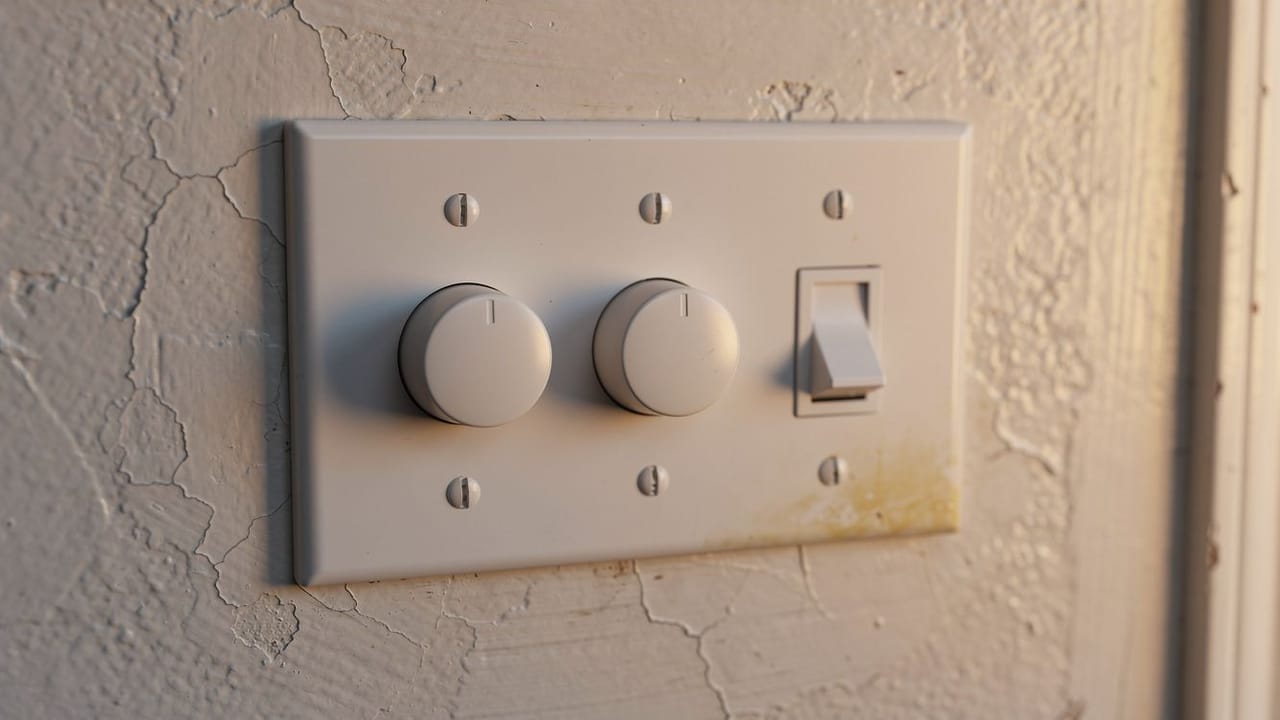
Discoloration often shows up before anyone notices the heat. A white plate yellows or browns along one edge, the switch toggle goes faintly tan, or there is a dark mark at a screw. Sound is the other early warning. A crackle or sizzle from a toggle switch is current arcing across a gap, which is exactly what a loose connection does. A dimmer can make a soft hum at some settings, especially with certain LED bulbs, and that is usually a compatibility matter rather than a hazard, but a dimmer that buzzes loudly, buzzes along with a smell, or buzzes and runs hot belongs on the same list as the crackling toggle.
- A plain on-off switch that feels warm
- Any switch or dimmer hot enough to pull your hand away
- A cover plate or toggle turning yellow, brown or dark
- Crackling, sizzling or loud buzzing from the switch
- Lights on that switch flickering or cutting out along with any of the above
Why do dimmers lose capacity when they share a box?
Dimmers mounted side by side cannot each shed their heat as well as one alone, so their wattage rating goes down. Lutron’s guide calls this derating, and for that dimmer it lists 600 watts for a single dimmer in its own box, 500 watts for one at the end of a row, and 400 watts for one in the middle of a row. Those numbers belong to that model, and other dimmers carry their own charts, but the pattern is the reason we read the chart for whatever dimmer is going in.
The same guide notes that derating is not needed for LED or CFL loads, which is one of the quieter benefits of moving off incandescent bulbs. Where it still matters is the kitchen or great room that got a three- or four-gang box of dimmers during a remodel while some of the fixtures on it kept older halogen or incandescent lamps. A middle dimmer in that row running a large incandescent load can be over its derated rating without anyone having added a single light.
Older homes around Nashville and Davidson County give us both halves of the problem: switch boxes that were sized for one or two toggles and now hold dimmers, and switches that have been on the wall for decades. Our post on what old wiring in Nashville homes means covers what we find behind those plates and when it becomes a bigger job.
What we check, and when a permit comes into it
With the breaker off, we pull the switch and look at the connections first: whether the wires are under the screws or pushed into back-stab holes, whether any insulation is browned or brittle, whether the box is crowded, and whether the switch itself shows scorching. Then we look at what the switch controls, because a switch that is fine on its own can be overloaded by what is on the circuit. Most of the time the switch repair is a new, properly rated switch or dimmer with the connections made under the screws, and the dimmer matched to the bulbs it runs.
If the job grows past that, the permit rules come in. Metro Nashville Codes’ permit table for renovating a single-family residence lists relocating a fixture, switch or outlet as electrical work that requires a permit. Moving a switch to a new spot, adding a box or running new cable is that kind of work, and we pull the permit for it. Outside Davidson County, the city or county permit office sets its own rules, and we check with that office before the work starts.
If a switch or dimmer in your house is warm, discolored or making noise, turn it off where you can, and ask us for an estimate. A flickering light on the same switch is worth mentioning too; our post on flickering lights and when they are dangerous covers the other causes we rule out.
Sources
- Lutron, Sunnata LED+ Dimmer installation guide (0302030) — Normal for the dimmer to feel warm during operation; derating when ganged (600 W single, 500 W end, 400 W middle for that model); no derating for LED/CFL loads.
- Electrical Safety Foundation, Give Your Home an Electrical Safety Checkup (copy hosted by the Kansas Corporation Commission) — Unusually warm switches may indicate unsafe wiring and a fire hazard; discoloration as heat buildup; crackling, buzzing or sizzling as a checklist sign; call a licensed electrician.
- Metro Nashville Codes, Renovate Single Family Residence — Relocating a fixture, switch or outlet is listed as electrical work requiring a permit.
FAQ
Warm or Buzzing Light Switch: Normal or a Problem — questions
Why is my light switch warm to the touch?
If it is a dimmer, mild warmth while the lights are on is normal, because a dimmer gives off heat as it controls brightness. A plain on-off switch has nothing inside that should warm up, so heat there usually means a loose or worn connection or too much load, and it should be checked by a licensed electrician.
Why is my dimmer switch hot?
A dimmer should feel warm, not hot. One that is hot enough to pull your hand away may be carrying more wattage than it is rated for, especially in a box with other dimmers, where ratings drop. It can also have a failing connection. Turn it off and have an electrician check the load, the dimmer and the wiring.
Why is my light switch buzzing?
A soft hum from a dimmer at some settings, often with certain LED bulbs, is usually a compatibility issue rather than a hazard. Crackling, sizzling or loud buzzing from any switch is different: it suggests current arcing at a loose connection. The Electrical Safety Foundation lists those sounds as a reason to call a licensed electrician.
Do dimmers need to be derated when ganged together?
Yes, for many loads. Dimmers side by side shed heat less well, so the manufacturer lowers each one’s rating. Lutron’s guide for one LED+ model lists 600 watts alone, 500 at the end of a row and 400 in the middle, and notes derating is not needed for LED or CFL loads. Each model has its own chart.
Is it safe to keep using a switch that is hot to the touch?
No. Leave it off and leave the lights it controls off until an electrician has looked at it. Heat at a plain switch or a hot dimmer means resistance or overload somewhere in the connection, and the Electrical Safety Foundation calls unusually warm switches a possible fire hazard. A discolored cover plate makes that more urgent.