
· by Michael Blair, Nashville's Electrician
When the outdoor holiday lights go up, an outlet that will not stay on is a common complaint, and the usual suspect is the GFCI, the outlet with the test and reset buttons. The tempting fix is to run a cord to an outlet without one. That removes the protection without touching the cause. Here is what a GFCI actually senses, why outdoor lights belong on one, how to tell a GFCI trip from a breaker trip, and what to check yourself before you call us for electrical troubleshooting.
Why do outdoor Christmas lights keep tripping the GFCI?
Outdoor Christmas lights trip a GFCI when some of the current leaving the outlet finds a way back other than the wire it is meant to return on. The U.S. Consumer Product Safety Commission’s fact sheet What Is a GFCI? (2010) explains that the device keeps comparing the current flowing out on a circuit with the current coming back, and shuts the power off in a fraction of a second if they differ by as little as 0.006 amperes. The CPSC defines a ground fault as an unintended path between a power source and a grounded surface.
On a string of lights outdoors, the likely places for that path are where water and wiring meet: a plug connection lying in wet grass, a cracked socket, a cord nicked by a staple or a sharp gutter edge. That is our explanation of how the leak happens rather than a line from the CPSC, but it fits the definition. Moisture or damage lets a little current reach ground, and the GFCI does what it was built to do. A trip after rain or heavy dew usually means the outlet is working.
Do outdoor Christmas lights need to be on a GFCI?
Outdoor Christmas lights need GFCI protection, and the federal safety advice says so directly. The CPSC’s December 2011 holiday safety alert told consumers to plug outdoor lights only into a GFCI-protected receptacle or a portable GFCI, and to check that the lights are certified for outdoor use. Outdoor receptacles have required GFCI protection under the National Electrical Code since 1973, according to the CPSC’s 2010 fact sheet, and Metro Nashville now enforces the 2023 edition of that code, per its adopted codes list.
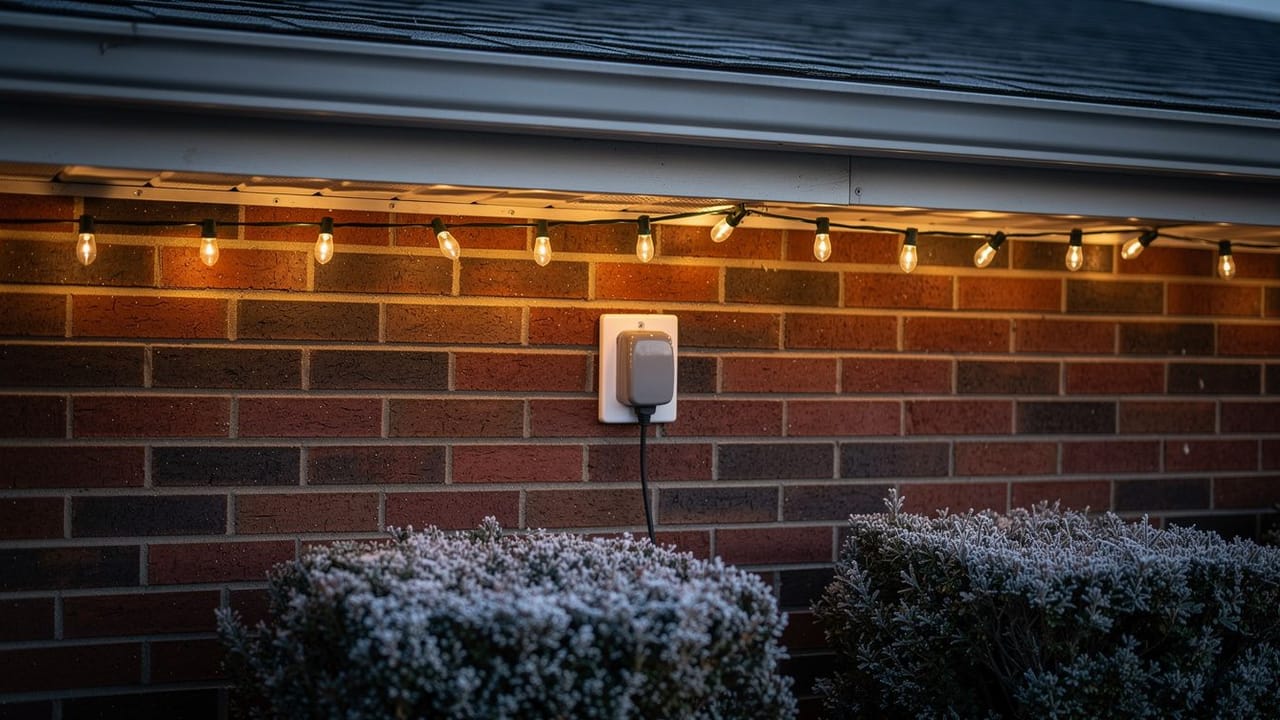
The receptacle matters as much as the protection. Leviton’s Lever Edge GFCI instruction sheet says a GFCI receptacle in a damp or wet location must be listed and marked weather resistant (WR), and that in a wet location it needs a cover or hood that keeps the receptacle and the plug face dry. A flat flip cover that cannot close over a cord is not doing that job while lights are plugged in. Our post on where GFCI and AFCI protection is required covers the rest of the house.
Is it the GFCI or the breaker that tripped?
The GFCI tripped if the outlet’s reset button has popped out while the breaker in the panel is still on; the breaker tripped if its handle has moved. The two respond to different problems. Leviton’s sheet states that a GFCI receptacle does not protect against circuit overloads or short circuits, which are the breaker’s job, so a breaker that trips as more strands go on points to too much load or a short rather than a ground fault. Our post on a breaker that keeps tripping works through those causes.
How many strands can share an outlet has no single answer. The National Fire Protection Association’s winter holiday safety tip sheet says to read the manufacturer’s instructions for the number of light strands to connect, and that number varies from one set to the next. The same sheet notes that some lights are made only for indoor or only for outdoor use.
What to check before you call an electrician
Check the lights first, then the outlet. The CPSC’s 2011 alert advises checking each set, including new ones, for damaged sockets, worn or exposed wiring and loose connections, and making sure each extension cord is rated for how it is being used; it also notes that UL’s red holographic label marks lights that meet requirements for indoor and outdoor use. NFPA adds that strings should hang from clips rather than nails so the cords are not damaged, that a string with worn cords or loose bulbs should be replaced, and that lights should be off when you leave or go to bed.
Then test the GFCI. The CPSC says to test each one monthly and after a power failure: plug in a lamp, press test and the lamp should go out, then press reset and it should come back on; if it does not, replace the GFCI. Leviton notes a GFCI will refuse to reset if it has no power, has its line and load wiring reversed, or fails its internal test. An outlet that will not reset with nothing plugged in, or an outdoor outlet without a weather-resistant cover, is work for our lighting and outlet service. Send us a note with what you are seeing.
Sources
- U.S. Consumer Product Safety Commission, What Is a GFCI?, Fact Sheet 099 (September 2010) — A GFCI interrupts power when outgoing and returning current differ by as little as 0.006 amperes; ground fault defined; outdoor receptacles under the NEC since 1973; monthly testing with a lamp
- U.S. Consumer Product Safety Commission, Holiday Safety Alert, release 12-054 (December 13, 2011) — Plug outdoor lights only into a GFCI-protected receptacle or portable GFCI; outdoor-certified lights; UL red holographic label; check sockets, wires, connections and extension cord ratings
- National Fire Protection Association, Winter Holiday Safety tip sheet (2025) — Indoor-only and outdoor-only lights; follow the manufacturer’s instructions on how many strands to connect; clips not nails; replace worn strings; turn lights off at night
- Leviton, Lever Edge GFCI Instruction Sheet PK-A3515 — Weather-resistant (WR) receptacles in damp or wet locations; wet-location cover that keeps the plug face dry; no protection against overloads or short circuits; reasons a GFCI will not reset
- Metro Nashville Codes, Adopted Codes List — Metro enforces the 2023 National Electrical Code
FAQ
Why Outdoor Christmas Lights Keep Tripping the GFCI — questions
Can Christmas lights be plugged into a GFCI outlet?
Outdoors, they should be. The U.S. Consumer Product Safety Commission’s 2011 holiday alert said to plug outdoor lights only into a GFCI-protected receptacle or a portable GFCI, and to use lights certified for outdoor use. A GFCI that trips on them is usually reacting to moisture or damage somewhere in the string or its connections.
How many strands of Christmas lights can you plug into one outlet?
There is no single number. The National Fire Protection Association says to read the manufacturer’s instructions for how many strands can be connected, and that figure changes from one set to another. A breaker that trips as more strands go on points to too much load or a short, which a GFCI does not guard against.
Does a GFCI trip when it rains?
It can, and that is usually the device working. A GFCI cuts power when outgoing and returning current differ by as little as 0.006 amperes, according to the CPSC, and water at a plug connection or a damaged cord can give current that path to ground. Leviton calls for a wet-location cover that keeps the plug face dry.
How often should you test a GFCI outlet?
Monthly, according to the CPSC, and also after installation, after a power failure and as the maker’s instructions say. Plug in a lamp and press test, and the lamp should go out; press reset and it should come back on. If it does not, the CPSC says the GFCI should be replaced.
Why do Christmas lights trip the breaker?
A breaker responds to overloads and short circuits, which Leviton says a GFCI receptacle does not protect against. If the panel breaker trips as more lights are added, the circuit may be carrying more than it should, or a damaged string may have a short. Check the strands and the maker’s connection limit first.